
Third Edition of the International Evaluation of Academic Research;
University of Kurdistan Ranked 601–800 in the Times Interdisciplinary Science Rankings 2027
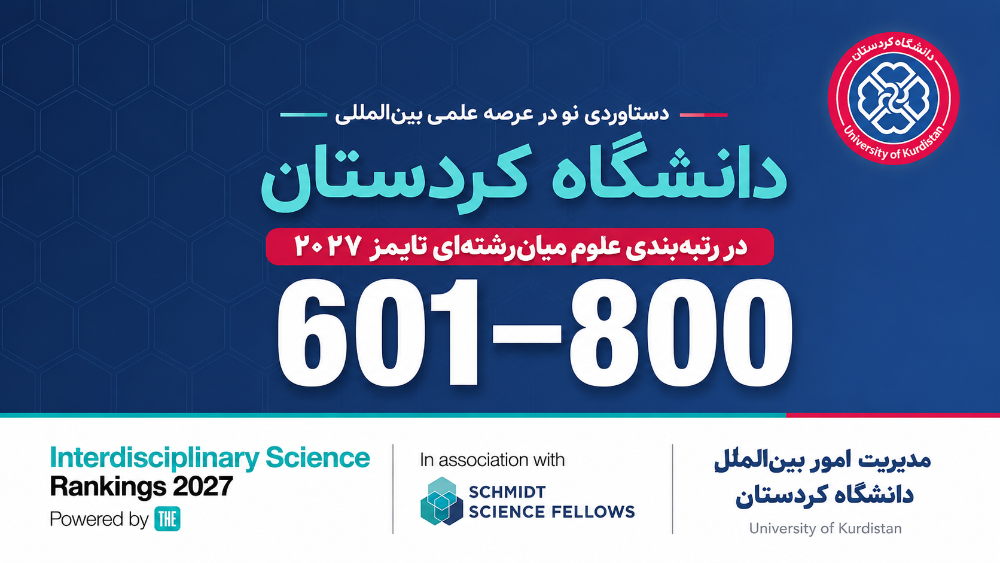



In the third edition of the 2027 Interdisciplinary Science Rankings of the Times institution, published in cooperation with the Schmidt Science Foundation, the University of Kurdistan was placed in the 601–800 global band. This system is the first dedicated international evaluation in this field.
The presence of the University of Kurdistan in this international table signifies meeting the entry requirements and being placed among institutions that have been evaluated globally under uniform criteria. The Directorate of International Affairs of the University of Kurdistan considers achieving this position the result of accurate and documented data submission, the continuous efforts of faculty members, researchers, students, and staff, and institutional attention to convergent scientific approaches.
The entry requirement for this ranking is publishing at least 100 interdisciplinary works over a five-year period and having at least 50 academic and research staff members in scientific fields. In the final table of this system, only the top 200 universities receive an exact numerical rank, and other eligible institutions are classified into various bands.
The Interdisciplinary Science Rankings of Times Higher Education specifically measures the contribution and institutional commitment of universities to interdisciplinary research. The theoretical basis of this evaluation is that responding to complex global challenges requires integrating knowledge, academic traditions, and methods from multiple fields; therefore, in addition to combining scientific disciplines with one another, its scope also encompasses linking sciences with social sciences, education, psychology, law, economics, and the clinical and health fields.
The methodology of this ranking is based on 11 indicators across three main pillars, with each pillar representing a stage in the life cycle of research projects. The "Inputs" pillar, weighted at 19 percent, measures the proportion of research income allocated to interdisciplinary science and the amount of industry funding per academic and research staff member. The "Process" pillar, weighted at 16 percent, evaluates documented and publicly available evidence regarding measures of interdisciplinary success, physical infrastructure, administrative support, and the promotion and tenure system for faculty members.
The "Outputs" pillar, which holds the highest weight in the final evaluation with a 65 percent share, examines the number and proportion of interdisciplinary publications, their utility and citation impact beyond the original discipline, research quality, and the university's academic reputation in the international survey of researchers.
The data sources for this ranking comprise three parts: institutional information submitted by universities through the official Times system (after validation), bibliometric data based on the Scopus database (Elsevier), and the results of a survey of active researchers. The full results of the Times Interdisciplinary Science Rankings 2027 and the details of its methodology are available on the official Times website at the following addresses:

Faculty Systems

Student Systems

Staff Systems

Virtual Tour

Telephone Directory

Privacy Policy Statement
Quick Links
Electronic Services
Useful Links


University of Kurdistan, Pasdaran Boulevard, Sanandaj, Iran

Postal Code: 6617715175

Phone: +988733664600-8

Email: info@uok.ac.ir


site visit
- today:
- yesterday:
- all:
Last Update
25 Nov 2026 - 07:05:34