
A scientific seminar focused on the re-evaluation of the book Gharbzadegi (Occidentosis) by Jalal Al-e-Ahmad was held at the University of Kurdistan.
An Overview of Jalal Al-e-Ahmad’s Intellectual Framework in "Gharbzadegi"
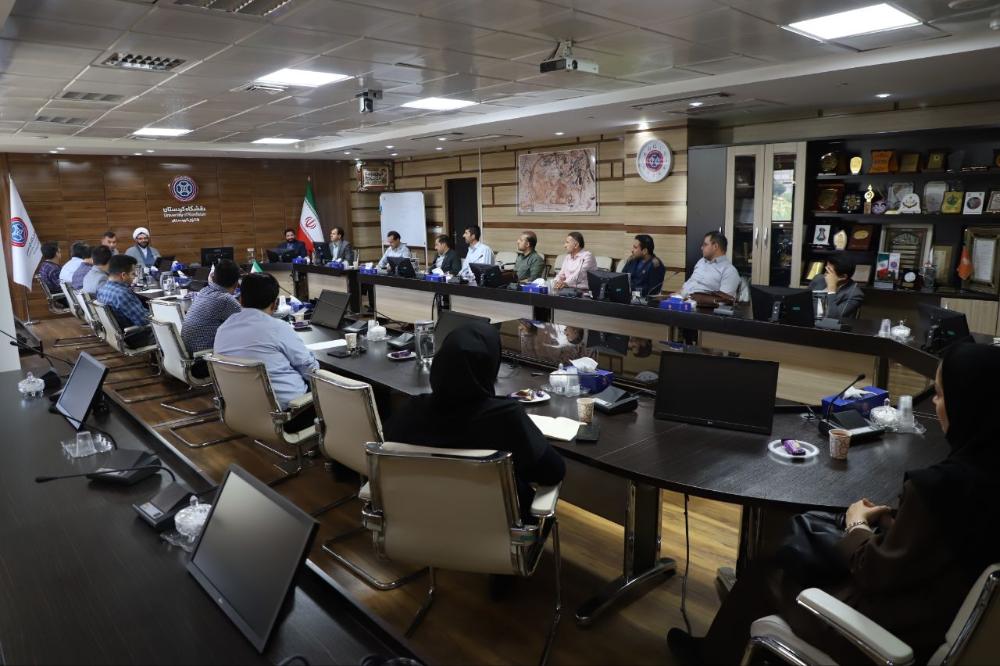



The session analyzed the historical contexts of the work's formation, the concept of "the West" in Al-e-Ahmad’s thought, and the primary intellectual and critical components regarding the social, cultural, and political transformations of contemporary Iran.
According to the Public Relations of the University of Kurdistan, the seminar took place on Sunday, May 31, 2026 (10 Khordad 1405), at the Presidential Conference Hall, featuring Dr. Babak Souri, a faculty member of the University of Kurdistan. The session explored one of the most significant critical and intellectual works in contemporary Iranian history from historical, social, and cultural perspectives.
At the beginning of the seminar, Dr. Babak Souri detailed the historical background of the book, noting: "Jalal Al-e-Ahmad authored Gharbzadegi in 1962 (1341 SH), a period deeply influenced by pivotal events in contemporary Iranian history." Dr. Souri further discussed Al-e-Ahmad’s life and legacy, stating that despite his relatively short life (1923–1969), he left an enduring impact on contemporary Persian literature, with Gharbzadegi standing as one of his most prominent works.
Regarding the concept of "the West" in Al-e-Ahmad’s thought, Dr. Souri added: "For Al-e-Ahmad, the West was not merely a geographical location; rather, it referred to societies characterized by technology-driven and industrial production. In contrast, the non-Western world comprised countries that possessed raw materials but lacked industrial production capabilities." He explained that based on this definition, Iran and many Eastern nations at the time were categorized as non-Western, while nations such as Britain, the United States, and industrial European countries represented the Western world.
Dr. Souri noted that in the third chapter of the book, Al-e-Ahmad defines Gharbzadegi as a social disease—a malady arising from imitation, dependency, and infatuation with the West and its manifestations. Al-e-Ahmad argued that any society functioning solely as a consumer without independent production capacity would inevitably fall victim to this condition.
Furthermore, Dr. Souri highlighted Al-e-Ahmad’s discussion on the role of foreign advisors, travelers, and representatives of Western powers in Iran’s transformations. Al-e-Ahmad believed that a significant portion of contemporary Iran’s intellectual and cultural changes was shaped by their influence. He also interpreted the execution of Sheikh Fazlullah Nuri as a sign of the retreat of traditional and religious currents in the face of Western encroachment.
Dr. Souri continued by explaining Al-e-Ahmad’s severe critique of Orientalism, which he analyzed in connection with Western colonial interests. From Al-e-Ahmad’s perspective, many Western Orientalists served political and colonial projects alongside their academic pursuits. He also maintained a critical view of international institutions such as the United Nations, UNESCO, the World Bank, and the IMF, viewing them as instruments serving the interests of major Western powers.
In conclusion, Dr. Souri emphasized that Al-e-Ahmad’s primary solution for overcoming Gharbzadegi was the achievement of independent production. Al-e-Ahmad believed that as long as Eastern countries remained mere consumers of foreign technology and products, they would never achieve true independence. He asserted that a society can only be independent if it possesses the capacity to produce its own technology and essential tools, rather than being a mere recipient of the achievements of others.

Faculty Systems

Student Systems

Staff Systems

Virtual Tour

Telephone Directory

Privacy Policy Statement
Quick Links
Electronic Services
Useful Links


University of Kurdistan, Pasdaran Boulevard, Sanandaj, Iran

Postal Code: 6617715175

Phone: +988733664600-8

Email: info@uok.ac.ir


site visit
- today:
- yesterday:
- all:
Last Update
23 Jun 2026 - 05:03:21