
The commemoration ceremony for the 47th anniversary of the victory of the Islamic Revolution was held at the University of Kurdistan, attended by the advisor to the head of the National Dar-al-Quran Organization and various provincial officials.
Commemoration Ceremony for the 47th Anniversary of the Islamic Revolution Held at the University of Kurdistan
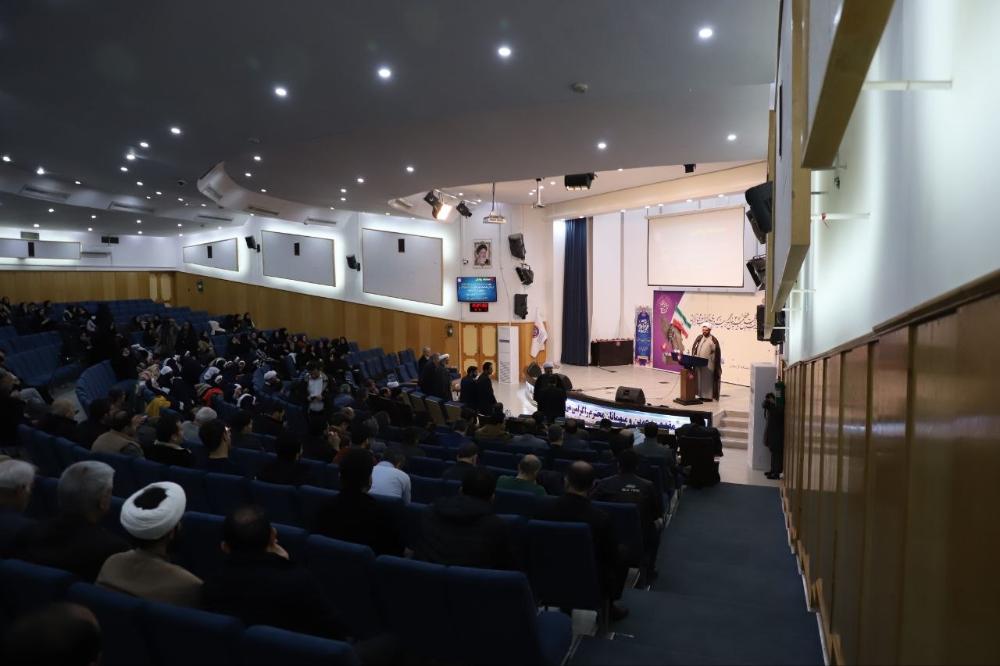



According to a report by the University of Kurdistan Public Relations, the ceremony took place on Monday, February 9 (20 Bahman), at the University’s Molavi Hall. During the event, speakers examined the foundations and achievements of the Islamic Revolution, emphasizing the role of the people, religious ideology, and effective leadership as the three primary pillars of the Revolution's success.
Scientific Progress and Human Dignity: Key Achievements of the Islamic Revolution
The Representative of the Supreme Leader in the Universities of Kurdistan Province emphasized the Revolution's role in scientific development and the enhancement of human dignity. Hojjatoleslam Hatami stated that universities must provide a secure and empowering environment for the scientific, ethical, and social growth of students and faculty. He noted: "Iran's current advancements in science and technology are the result of the nation's resistance against hegemony and the dismissive attitudes of global powers." He added that reviewing pre-revolutionary historical realities is essential for a correct understanding of today's achievements.
Referring to the demeaning policies of the pre-revolutionary era, Hojjatoleslam Hatami cited the passage of unjust laws such as "Capitulation" as clear attempts to strip the nation of its independence. However, the Revolution, led by Imam Khomeini (RA), dismantled these imposed structures. He further highlighted Iran's global standing in various scientific indicators, including medicine, biotechnology, stem cells, organ transplantation, and emerging technologies. He remarked that sanctions and external pressures are designed to halt this progress, as enemies recognize that "science is power." He concluded by noting that while fair criticism and addressing shortcomings are necessary, one must not allow media propaganda to overshadow the reality of the country's capacities.
Academics’ Success Rooted in Following Revolutionary Ideals
The Representative of the Supreme Leader at the University of Kurdistan, Hojjatoleslam Abedin Rostami, analyzed the foundations of the Islamic Revolution. He stated: "In the analysis of any successful revolution, three pillars are essential: the people, ideology, and leadership. As long as these causes remain, the Revolution will continue its path."
Hojjatoleslam Rostami compared the Islamic Revolution with previous Iranian movements, such as the Tobacco Protest, the Jangal Movement, the Constitutional Revolution, and the Nationalization of the Iranian Oil Industry. He noted that those movements failed to achieve sustainable results because they lacked the simultaneous completion of these three pillars. He concluded that current sanctions and cultural attacks specifically target these three foundations, and expressed hope that the academic community, by adhering to religious and revolutionary teachings, would succeed in its scientific and social responsibilities.


Quick Links
Electronic Services
Useful Links


University of Kurdistan, Pasdaran Boulevard, Sanandaj, Iran

Postal Code: 6617715175

Phone: +988733664600-8

Email: info@uok.ac.ir


site visit
- today:
- yesterday:
- all:
Last Update
17 Feb 2026 - 10:53:31